 A trip was organized by Great Dixter (Thank you!!!) for Mark and myself to visit a garden called Kerdalo, in the Brittany region in France. We caught a ferry from England which took us on a 5 hour trip across the Channel to Roscoff.
  Roscoff was a small port town that had such charm with lots of stone architecture and small cobbled streets.
 While maneuvering through the small villages and towns to reach Kerdalo, I saw these boats planted up in one of the rivers. I thought that it was a really nice touch, very unexpected.
 There are crop fields that seem to be everywhere you look. Artichokes were the most exciting with there globular heads swaying back and forth in strong winds.
 Once they start to bloom, worry not, they are then sold as cut flowers like I had seen in Roscoff.
  Finally, after a few wrong turns and many misunderstood traffic signs later we pulled onto some back roads that led us to Kerdalo. Kerdalo has a rich history having been started in 1965 by the gardener and painter Peter Wolkonsky. The house was built in a valley that encompasses 45 acres of land. Kerdalo is centered around the manor house, which used to be an old farmhouse, which is all situated in a valley.
The gardens are composed of terraces, fully visible from inside the house at the back, a formal garden around the house and in front, natural springs which feed a series of lakes, ponds, and pools. There are meadows, an Auaucaria araucana meadow(!!), streams filled with ferns and Gunneras, and architectural gems hidden throughout. These little buildings were all created and built by Peter Wonkonsky.
The garden is laid out wonderfully and is run now by his daughter Isabelle Vaughan and her husband Timothy.

 This is a view, from above, of the Jardin des Quatre Carres, or Garden of the Four Squares. Something that I really enjoyed was the fact that no visitors are allowed to walk in this area, which forces you to really take it all in and appreciate it rather than people walking through it and spoiling the view. It created a feeling of desire....
 This part of the garden is composed of squares of planting beds surrounded by turf and squares set with stones in geometric patterns. This whole area is enclosed in a stone wall which lets the visitors eye extend to the gardens beyond, which are planted in a more naturalistic style, bringing your eyes to rest at the lake at the bottom.
 The formal garden beds designed to be at their best in summer.
 The plantings are made up of strokes of whites, blues, yellows, and purples.
 These are primarily from Romneya coulteri, Geranium 'Roxanne', Coreopsis verticillata 'Moonbeam', Allium sphaerocephalum, Melianthus major, Hakonechloa macra 'Aurea',Festuca glauca, Phlox paniculata, and Miscanthus sinensis 'Morning Light'. The Boxwood also acts as structure within the garden beds.
  Here you have the stone buildings which were erected by Peter, where he designed and created the ornamentation inside.
 Inside there are intricate murals made of shells and stone of all shapes and sizes.
Wonderfully executed.
 The intricate detail of the animals inside such as this bird,
 monkey, and
 goat. Each piece was unique and demanded its own time for attention.
 Here you have the full view of the house, with its amazing stonework, with the steps leading into the garden of the four squares.
  This is a pencil sketch of the back of the manor house, where the terraces are planted with lots of exotic and rare plants. There was a Shefflera impressa, Acacia pravissima and Puya alpestris. I was really excited while doing this sketch and bird crap happened to land on it, hence the brown smudges. Is it a sign?!
 This is one shot from inside the house of the stairs, which transported me to another place. I felt as if I was in a Giorgio d Chirico painting, a place of dreams, soft light, and perspective.
 A sketch for the thank you to Isabelle, the owner.
There is an area called the Golden Heath at Kerdalo, that just seems to light up once the setting sun hits it.
 At the lake you are mesmerized by the large foliage of Gunnera manicata and the intense jewel tones of the blooms of the Hydrangea. The reflection in the water held my eyes for a long time. The blooms are so small and intricate changing in color from pinks to purples to the most vivid blues, all while the gentle giant Gunnera foliage extend outward to greet you.
  And from inside the Gunnera you have an even more intense blue piercing through the woodlands on the other side. I will always fall for a beautiful blue anywhere.
There were so many beautiful areas in the garden that it was impossible to share them all, hopefully a link to all other photos will be in place......
 Once you come to the bottom of the valley that Kerdalo sits in you are treated to a view of the town Tredarzec from across the river Jaudy.
 This is the view up the river towards the bridge. I found a piece of charcoal on the ground and just got inspired, or was it the wine.............
 After Kerdalo we went towards the coast to where we were staying, which was right on the coast(o.k. it was really just a 2 minute walk), and it is probably the craggiest coast I have ever seen. All you hear are the waves crashing into the rocks...
 This is a house that is right on the coast , could you imagine living here?
  Now I take you to Crech ar Pape, Isabelle's other garden. To be here in this garden was a complete delight and shock to all of my senses. It was like a cubist dream, a garden of shapes and textures with the ingredients of control and chaos fighting it out. I am still in awe of it.
  This is the view of the entry into the garden from the guest cottage. The garden was designed around the base of a Celt design. You would never know that in the French countryside, right on the coast, there is a garden that exists like this. The whole garden is made up of a series of rooms, with the walls being Laurelis nobilensis, or Bay Laurel.
  There are alot of clipped shrubs such as Boxwood, Osmanthus heterophyllus 'Variegata', Hebe parviflora 'Angustifolia' which relinquishes control to the herbaceous perennials to Hakenechloa macra and H. macra 'Aurea', Anemone x hybrida, Agapanthus and lots of self sowers such as Verbena bonariensis and Erigeron karvinskianus.
The garden gave so many views from so many different angles I didn't know where to stop to take it all in. The plants seemed to walk and tuck themselves into tight little spaces between shrubs. This photo is only about 5 feet away from where the one above it was taken and look at the difference. The roof of the guest cottage is so sharp in comparison to all of the soft circular forms that fall below it. 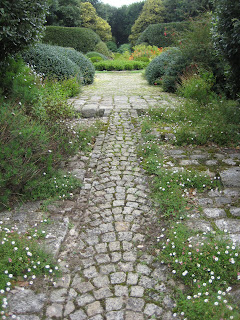 This is a detail of the stone pavers, which came from the streets in France when they started to pave the roads. I am sure this detail is very useful in getting the wheelbarrow to the other parts of the garden. See all the Erigeron karvinskianus nestled in between the pavers. This takes us into the next part of the garden which is a large circular room, again a case study in shape and form with color to pull it all together.
  You can see the urn in the back which acted as the center, or focal point, of the first garden room which is rectangular.
  Notice the pavers and the subtle tones of blue and green.
  I would be very excited to see this garden in the winter with a light dusting of snow. Isabelle was saying that there used to be alot more plants in here but as Peter gets older, he has been simplifying the planting by removing some and leaving the grasses and shrubs. A garden is never done...
Here is a boxwood hedge, just walking itself up, or is it down, the steps. Where would you see such a thing?!This is a detail of the stone pavers, which came from the streets in France when they started to pave the roads. I am sure this detail is very useful in getting the wheelbarrow to the other parts of the garden. See all the Erigeron karvinskianus nestled in between the pavers. This takes us into the next part of the garden which is a large circular room, again a case study in shape and form with color to pull it all together. You can see the urn in the back which acted as the center, or focal point, of the first garden room which is rectangular. Notice the pavers and the subtle tones of blue and green. I would be very excited to see this garden in the winter with a light dusting of snow. Isabelle was saying that there used to be alot more plants in here but as Peter gets older, he has been simplifying the planting by removing some and leaving the grasses and shrubs. A garden is never done... This was another discovered area for me which was right off the main house, which that is the library straight ahead. It is such a contradiction, which I find fascinating, that it blurs between chaos and order. Notice how well the Agapanthus and Crocosmia form a burst of color in small pockets.
 What you thought was a pool of water from afar actually turned out to be a sunken seating pit occupied by communities of self sowers and creepers.
 The vines on the walls were clipped into the shape of two elephants joined together by holding their trunks.
 I have nothing to say, just look at that.......
 Needless to say, I have truly been inspired to do more.
 This is the view from the guest cottage with Cotinus coggygria in the background. Never really thought about this shrub much but I think my mind has been changed...


 This was the entrance to the 2 acre forest garden, which was on site of the course, and is a 13 year old established garden. The idea is to have it be where you get the maximum output for minimum input by creating these ecosystems.


 Posts
Posts

